
Nobly Alone
On confronting the human condition


I’ve recently had to walk away from a community that was fraught and dear to me in equal measure. I won’t go into the gory details and instead simply say there is a special kind of grief in walking away from a beloved group.
Departures such as these are a sort of breakup, and the post-breakup world is always hard to navigate. I thought I would take a moment to reflect on the challenges of community and what I have learned by leaving it.
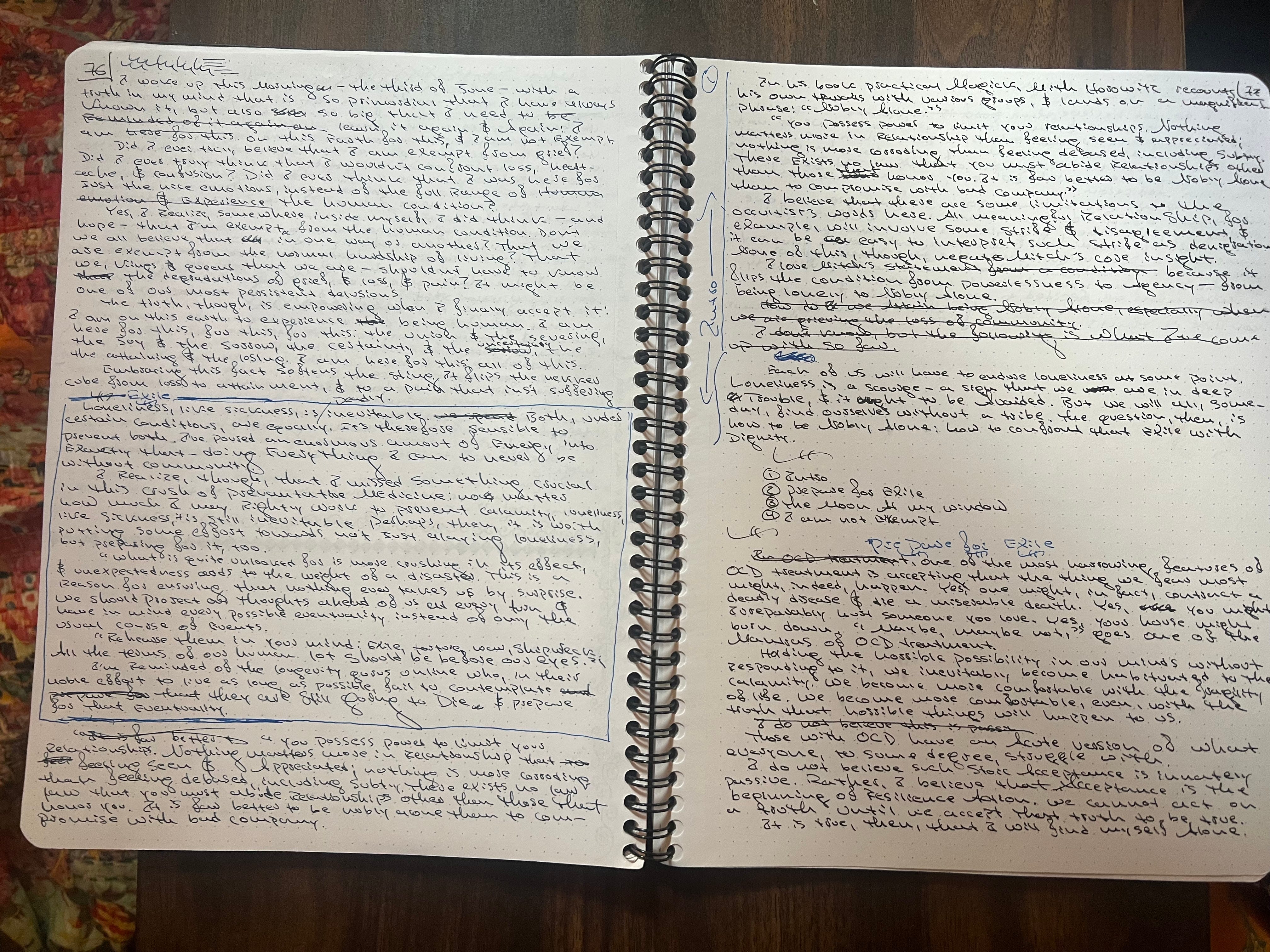
In his book Practical Magick, renowned occult scholar 𝐌𝐢𝐭𝐜𝐡 𝐇𝐨𝐫𝐨𝐰𝐢𝐭𝐳 recounts his own travails with various groups and lands on a magnificent turn of phrase.
“You possess power to limit your relationships,” he writes. “Nothing matters more in relationship than feeling seen and appreciated; nothing is more corroding than feeling debased, including subtly. There exists no law that you must abide relationships other than those that honor you. It is far better to be nobly alone than to compromise with bad company.”
I believe that there are some limitations to the occultist’s words here if they are not balanced with countervailing principles. All meaningful relationships, for example, will involve some strife and disagreement, and it can be easy to interpret such strife as denigration. This does not, though, negate Horowitz’s core insight.
I love his statement because it flips the condition of loneliness from powerlessness to agency, from being lonely to nobly alone.
Loneliness is a scourge, a sign that we are in deep trouble, and it ought to be avoided. But we will all, someday, find ourselves without a tribe. The question, then, is how to be nobly alone and confront that exile with dignity.
As with all things, resilience during hardship starts long before the trial comes. Loneliness, like sickness, is inevitable. Both are equally deadly. It’s sensible to prevent both. I’ve poured enormous amounts of energy into doing everything I possibly can to never be lonely again.
I realize, though, that I missed something crucial in this crush of preventative medicine: no matter how much I may rightly work to prevent calamity, it will still happen. I’m reminded of the longevity gurus online who, in their noble effort to live as long as possible, seem to forget that they are still going to die. It’s worth putting some effort towards not just allaying loneliness, but preparing for it.
“What is quite unlooked for is more crushing in its effect, and unexpectedness adds to the weight of a disaster...” writes Seneca in his letters to Lucilius. “This is a reason for ensuring that nothing ever takes us by surprise ...Rehearse them in your mind: exile, torture, war, shipwreck. All the terms of our human lot should be before our eyes.”
This core insight has, like a great deal of ancient wisdom, worked its way into modern therapy. One of the most harrowing features of OCD treatment, for example, is accepting that the thing we fear the most might indeed happen. Yes, you might contract a deadly disease and die a miserable death. Yes, you might irreparably hurt someone you love. Yes, your house might burn down. “Maybe, maybe not,” goes one of the mantras in OCD treatment.
Holding the horrible possibility in our minds without responding to it, just as Seneca instructs, habituates us to the calamity. We become more comfortable with the fragility of life, and that allows us to be more resilient and resourceful when disaster comes.
Those with OCD have an acute version of the terror at human fragility, but we all share this fear in one way or another, and there might be no greater fear than of being alone. Contemplating loneliness, then, is a prerequisite for being nobly alone.
I do not believe such stoic acceptance is innately passive. Rather, acceptance is the beginning of resilient action. We cannot act on the truth until we accept it as true.
I woke up this morning, the third of June, with a truth in my mind that is so primordial that I have always known it, but also so big that I need to learn it again and again: I am on earth for this.
Did I ever truly believe that I am exempt from grief? Did I ever truly think that I wouldn’t confront loss, heartache, and confusion? Did I truly believe that I was just here for the nice emotions instead of the full range of the human condition?
Yes, I realize: somewhere inside myself, I did think that I’m exempt from the human condition. Don’t we all believe that in one way or another? That we are exempt from the normal hardships of living? That we, kings and queens that we are, shouldn’t have to know the degradations of grief, loss, and loneliness? It might be our most persistent delusion.
The truth, though, is empowering when I finally accept it: I am on this earth to be human. I am here for this, for this, for this: the union and the severing, the joy and the sorrow, the connection and the loneliness. I am here for all of this.
Embracing this truth softens the sting of loneliness. It flips the necker cube from loss to attainment.
The last time I experienced the loss of community, it was, as usual, poetry that came to my aid. A Zen Buddhist Monk’s haiku landed in my psyche as a compass.
Ryokan, an 18th-century monk, came home one day to find that a thief had pilfered his tiny shack and taken what few, essential possessions he had.
Reflecting on this disaster, which would leave most of us panicked and angry, he wrote,
The thief left it behind:
The moon
At my window
It is crucial, after loss and the inevitable loneliness that follows, to recognize what is left behind. There is always something of great value, something that will be the key or consolation to carry you through.
In Zen Buddhism, the moon represents enlightenment, but to my eye it also represents a myriad of mundane things that are crucial for survival:
The capacity to see beauty in the moon, in nature, in music, in people.
The relationships that are still in your life, and the simple animal warmth of a friend.
The security of a roof over your head, and the nourishment of good food.
Your resilience, your capacity to heal, and the principles that guide you.
How do we be nobly alone? We look to the moon and discover what remains.
But that’s just me. What do you think? Let me know in the comments section, and if your comment is excellent, I might feature it in an upcoming post.
I have taken a Pro-Human Pledge. This article was drafted by hand, edited in Microsoft Word, and is untouched by AI. To support human-grown creativity, please subscribe to my work.
You might also enjoy:
In a breakup letter to her beau, my mother wrote, "It would be far better to be alone than lonely."
Since then, I've held this distinction, and your essay surfaced this memory. Firstly, thank you for that pleasant nostalgia.
It also made me wonder about the distinction. Are loneliness and aloneness the same?
Aww, I'm sorry to hear that, Stephen. That kind of ending can be so painful and frustrating because you feel like you should have been able to fix it, to keep the situation from derailing, to somehow sail through those increasingly narrow straits. And then you have to face it that you can't. And then there is nothing left but to get used to it, crawl up on the beaches, and walk on.