
Little Suicides
An Ill-Advised Coping Skill


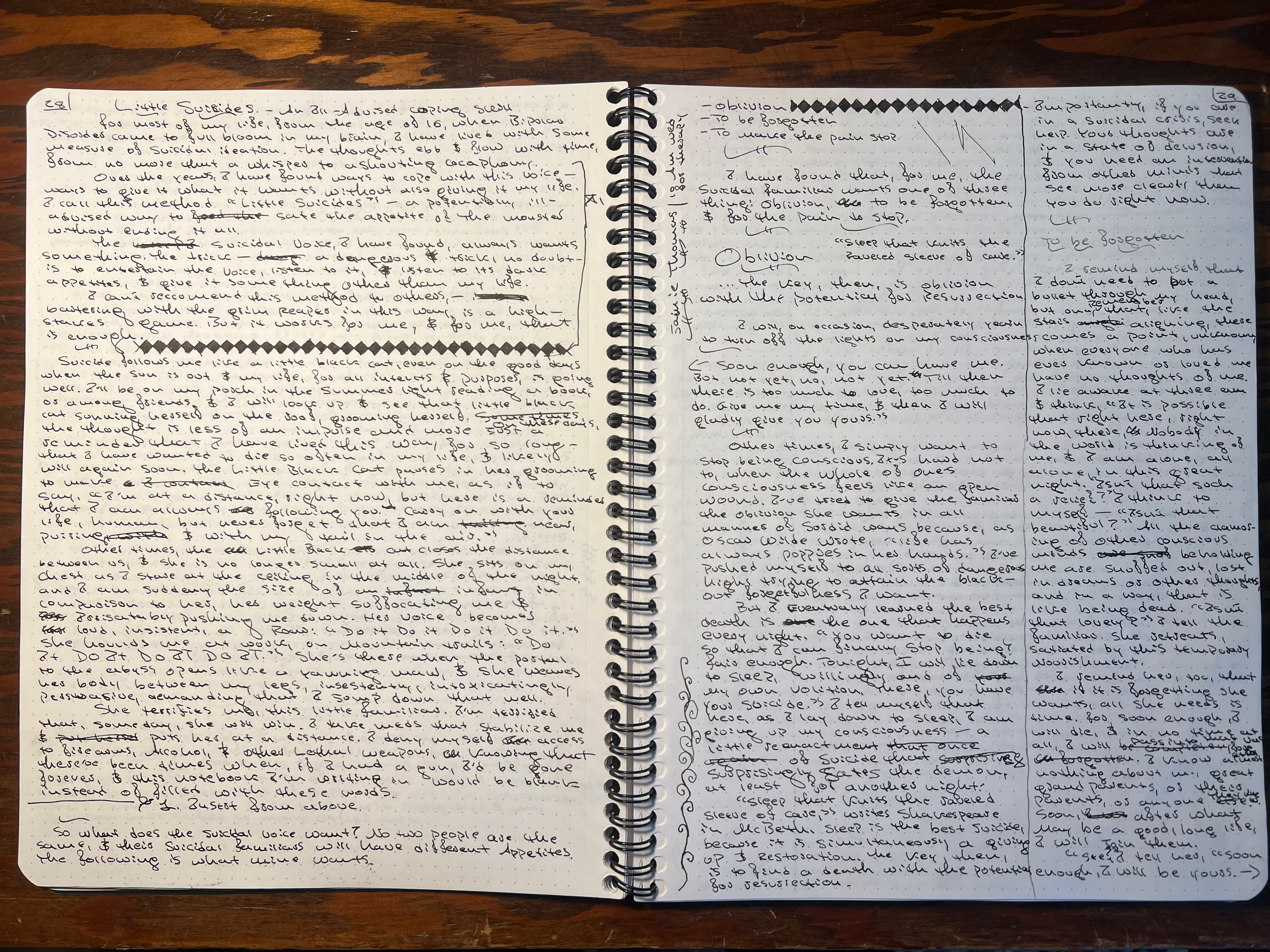
Ever since I was 16, when Bipolar Disorder came to full bloom in my brain, I have lived with some measure of suicidal ideation.
Suicide follows me like a little black cat, even on the good days when the sun is out and my life is going well. I’ll be on my porch in the summer light reading a book, and I look up and see that little black cat sunning herself on the roof. On these days, she is less of an impulse and more a reminder that I have lived this way for so long that I have wanted to die so often in my life, and likely will again soon.
The little black cat pauses in her grooming to make eye contact with me, as if to say, “I’m at a distance now, human, but here is a reminder that I am always following you. Carry on with your life, but never forget that I am near, purring, with my tail in the air.”
Other times, she closes the distance between us, and she is no longer small at all. She sits on my chest as I stare at the ceiling in the middle of the night, her weight that of a tiger on top of me. Her voice becomes loud, insistent, a roar: “do it do it do it do it.”
She’s there at the worst moments, when the portal to the abyss opens like a yawning maw, and she weaves her body between my legs, demanding I throw myself down that well.
She terrifies me, my little Familiar. I’m terrified that, some day, she will win. I live with the knowledge that the next major episode could very well be my last. I take meds that stabilize me and put her at a distance. I regiment my life, building a bulwark against despair with social connection, discipline, sleep, diet, and exercise. I deny myself access to lethal means, knowing that there have been times when, if I had a gun, I’d be gone and my notebook would be blank instead of full of these words.
Over the years, I have found ways to cope with my Familiar — ways to give her what she wants without also giving her my life. I call this method “little suicides,” a potentially ill-advised way to sate the appetite of the monster.
The suicidal voice, I have found, always wants something. The trick — a dangerous trick, no doubt — is to entertain the voice, listen to her needs, and give it something other than my life.
I can’t recommend this method to others. Bartering with the Familiar in this way is a high-stakes game. I am not a therapist or mental healthcare professional, and I am not encouraging anyone to follow what I describe here. This is art, not medical advice. It is an exploration of the darkest voice in my head and an attempt to find purpose and beauty in that voice.
If you are in the middle of a crisis, please stop reading and reach out to support or call the crisis line at 988. I have called the hotline myself and benefitted from it.
So what, for me, does The Familiar want? She wants one of three things: to be forgotten, to be unconscious, and to make the pain stop. The trick is to help the familiar learn that what she wants, she already has, and what she thinks she wants, she doesn’t.
To Be Forgotten
When things get dark, I become possessed by an overwhelming desire to be invisible and forgotten by the world. I want to be unseen and unremembered, and death feels like the best way to attain that.
There’s no logic here. Suicide doesn’t erase the memory of me or the devastation of my death on those who love me. But that’s depression brain for you: as compelling as it is incoherent.
After confronting this state over and over again through my life, I’ve found a way to fool the Familiar. I tell her that, at unknown intervals, there are moments when everyone who has ever known or loved me have no thoughts of me. I lie awake at three AM and think, “it is possible that right here, right now, nobody in the world is thinking of me. I am all alone in this enormous night. Isn’t that beautiful?” All the clamoring of other conscious minds beholding me are elsewhere, lost in dreams or other thoughts, and in a way, that is like being dead. “Isn’t that lovely?” I tell the Familiar. She retreats, satiated by this temporary nourishment.
I remind her, too, that if it is forgetting she wants, all she needs is time. Soon enough, I will die, and in no time at all I will pass into that vast forgetfulness that we all, inevitably, must enter. I know almost nothing about my great grandparents, or their parents, or anyone they knew. Someday, I will join them in just 2 or 3 generations.
“Soon, you will have forgotten the world,” writes Marcus Aurelius, “and the world will have forgotten you.” I commit these words to memory to remind my Familiar.
“See?” I tell her, “Soon enough, I will be yours. But not yet. Till then, there is too much to love, to much to do. Give me my time, and then I will gladly give you yours.”
To Be Unconscious
Other times, I simply want to stop being conscious. It’s hard not to, when the whole of one’s consciousness feels like a sentient open wound. Killing myself is the ultimate black-out, and the Familiar is particularly skillful at suggesting that method when I need to get outside of myself.
Over the years, I’ve tried to give The Familiar her oblivion in all manner of sordid ways. I’ve pushed myself to all sorts of highs trying to attain the black out I want. These methods are dangerous, because they very well could kill me — if not in the moment, then cumalatively. They’ve also resulted in addiction and compounding chaos over the years.
I eventually learned that some numb-outs are better than others. The black-out pleasure of sex works. Tattooing by a skilled artist is another method to attain the void. Brutal exercise becomes a sort of spiritual self-annihilation, and non-dual meditation — deliberately looking for the self and realizing its non-existence — provides immense relief.
Readers will be quick to point out that this is the manifestation of an unhealthy mind. Of course it is. I’ll never claim to be a saint, a bodhisatvha, or an ascended master. Give me Saint Paul for my money: “I’m the chief among sinners.”
But I’ve also come to realize that ego-death, no matter how dark, is a universal human need. We are all yearning to worship, to undergo Theosis and be absorbed into a God. My impulse might be extreme, but it is part of a nature we all share. It is our choice to channel that impulse towards constructive or destructive ends.
I eventually learned that the most reliable ego death is the one that happens every night. “You want me to die so that I can finally not be conscious?” I tell the Familiar, “So be it. Tonight, I will lie down and enter the black night of dreams and nothingness. There, you have your little suicide.” Going to bed is a little re-enactment of death that surprisingly sates the demon, at least for a day.
“Sleep that knits up the ravell’d sleave of care,” writes Shakespeare in MacBeth,
“The death of each day’s life, sore labour’s bath,
Balm of hurt minds, great nature’s second course,
Chief nourisher in life’s feast.”
This “death of each day’s life” is one with a resurrection and the potential for greater healing, clarity, and life. And this gets to the most fundamental need of The Familiar.
To make the pain stop
More than anything, the Familiar wants to put out the fire in my mind, and here she might have a perverse wisdom — she’s right that something needs to die.
It is usually ego, or terror, or shame, or embarrassment, or a searing conviction that I am all alone, that needs to die. These impulses are all-consuming in the midst of a suicidal episode, and they feel as inseparable from me as my own skin. Ripping that skin off and casting it aside feels just as terrifying, if not more so, than ending my life.
I trick the Familiar and turn her own logic against her. I can channel the suicidal impulse into killing the things keeping me from being well. This is, indeed, a death, and you will never know how terrifying a death it is until you have faced it in a mental health crisis.
The death might be giving myself up to the medical system: a terrifying free fall into uncertainty. Or it might be killing my pride and collapsing into the arms of a friend, the care of my family, or the comfort of my partner. It means, too, allowing parts of my personality, or story, or values, to be seared away by the pain I’m experiencing. All of these are an apocalypse, an ending and a beginning.
So, you want suicide, Little Black Cat? I will commit suicide by killing my ego, my pride, my fear of being a burden, and throwing myself into the support of others. I will die by asking for help, I will make an even greater risk than death and trust someone else with my health. There, you have your suicide.
This is what she always wanted, beneath her terrifying words and fantasies: she wanted death and rebirth. She was just confused about how to get it.
But that’s just me. What do you think? Let me know in the comments section, and if your comment is excellent, I might feature it in an upcoming post.
I have taken a Pro-Human Pledge. This article was drafted by hand, edited in Microsoft Word, and is untouched by AI. To support human-grown creativity, please subscribe to my work.
Half of my work is behind a paywall, and this Substack is a crucial part of my income. Please consider becoming a paid or free subscriber with the button below.
If you want a paid subscription but can’t afford it, DM me or reply to this email, and I will grant you six months free, no questions asked.
Don’t want to become a paid subscriber? Buy me a coffee instead.
For anyone reading this who avoids asking for help because they don’t want to bother anyone:
Some of us actually love being helpful, in the same way some people love roller coasters or seeing their favorite band in concert.
This is going to sound all me-me-me but do you know what an honor it is when someone chooses YOU to call when they’re freaking out?
When someone trusts you enough to just spill all the shit they’ve been holding in?
That is the highest compliment there is.
I’m not a therapist either but I am listening to Richard Schwartz’s work on internal family systems and the notion of each person containing various parts, exiles and protectors. Yesterday he discussed the suicidal part, and what you do with your Familiar sounds very much like what he described for managing that part.
I’m so grateful for what you share with us.